
How ANZGOG’s Patient Referral Network is unlocking new opportunities for industry
At the 52nd COSA Annual Scientific Meeting and 26th IPOS Annual World Congress, ANZGOG’s Research Program and Pipeline Manager, John Andrews, presented insights on TREETOP. ANZGOG’s initiative is designed to strengthen our Patient Referral Network and expand access to clinical trials for underserved and priority populations across Australia and New Zealand.
To find out more, we asked John Andrews to share insight into the importance of ANZGOG’s Patient Referral Network and how it has benefited the way gynaecological cancer research is conducted.
Question: ANZGOG now has 86 research-ready sites. How diverse are these sites, and what are the benefits of clinical trial participation having so many sites?
Answer: ANZGOG regularly collects key information about each affiliated hospital site, including their capabilities and capacity to conduct gynaecological cancer clinical trials. This provides valuable insights into how patients are referred through networks of rural, regional and metropolitan hospitals, including both formal satellite sites and informal referral pathways. This unique project is now known as TREETOP, which offers a “bird’s-eye view” of the patient referral networks across Australia and New Zealand.
Understanding how patients move through their local, regional and State/Territory health systems for treatment is essential to ensuring equitable access to clinical trials and personalised care. Treatment pathways differ across gynaecological cancers, for example, some patients may require specialised surgery that is only available in major metropolitan centres. Larger tertiary hospitals also manage high patient volumes, and it is important to recognise how this affects their capacity to open and conduct clinical trials.
Question: Where is the benefit of this network for women diagnosed with gynaecological cancers, particularly for priority populations?
Answer: Priority populations are a key focus for ANZGOG. These include people from Culturally and Linguistically Diverse (CALD) backgrounds, LGBTQIA+ communities, Aboriginal and Torres Strait Islander peoples, wāhine Māori and Pacific women, as well as those living in regional, rural and remote areas. By gaining a clearer understanding of where these communities live and receive care, ANZGOG aims to improve the accessibility of its clinical trials and ensure they better reflect the needs and experiences of all communities.
The TREETOP, Patient Referral Network project layers current health data with the known referral pathways to identify where satellite sites (smaller hospitals and community health centres) can be opened to clinical trial recruitment to capture a larger number of priority populations directly, closer to where they live. Ensuring clinical trials are available closer to where people live is vital to the delivery of equitable health care in Australia and New Zealand.
Question: Given the rich diversity of sites in the network, where are the opportunities for collaboration between ANZGOG, industry and members?
Answer: Leveraging an established health network to identify suitable sites for clinical trials enables ANZGOG to:
(a) support its members in making clinical trial opportunities more equitable and accessible;
(b) allowing an opportunity for industry partners to engage with a broad and diverse patient population for research; and
(c) identify opportunities for collaborative, investigator-initiated research within ANZGOG’s membership.
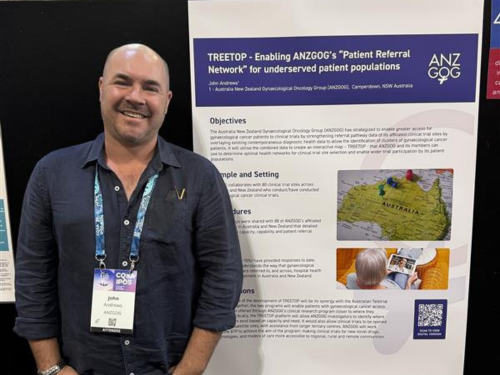
ANZGOG’s John Andrews presenting the TREETOP poster at the 52nd COSA Annual Scientific Meeting and 26th IPOS Annual World Congress in November 2025.