
Professor Paul Cohen presents highlights from the recent ASCO Annual Meeting held in Chicago, USA, from May 30 – June 3, 2025.
The American Society of Clinical Oncology (ASCO) is the leading professional organisation for oncology professionals caring for people with cancer. The ASCO Annual Meeting highlights key breakthroughs in cancer research and clinical trials and is the world’s largest clinical cancer research conference. Professor Paul Cohen, Chair of ANZGOG’s Research Advisory Committee, attended this year’s ASCO Annual Meeting together with other ANZGOG members, and has provided a summary report of the meeting’s gynaecological cancer highlights. Attending international meetings like ASCO enables ANZGOG to forge strong collaborations and allows members to stay at the forefront of the latest research developments.
Contributed by:

Professor Paul Cohen
ANZGOG – Director,
Chair – Research Advisory Committee
Highlights from ASCO 2025
This year’s meeting hosted over 40,000 delegates from more than 100 countries. There were excellent education sessions and new gynaecological cancer research presented in oral, rapid oral, and poster presentations. This year’s theme was “Driving Knowledge to Action: Building a Better Future.”
Ovarian Cancer
TRUST was a randomised trial comparing primary cytoreductive surgery (PCS) to interval cytoreductive surgery (ICS) in advanced ovarian cancer. A benefit for PCS was observed although the study did not meet its primary endpoint of overall survival (OS). Notably, there was a significant PFS benefit in favour of PCS for the sub-group of patients in whom complete gross resection was achieved (median PFS 27.9 vs 21.8 months; HR = 0.69; p=0.0009). The findings reinforce PCS as the standard of care for patients with good performance status and resectable disease. The study emphasises the importance of complete gross resection, surgical quality assurance, and treatment at accredited ovarian cancer centres.
The phase 3 ROSELLA trial evaluated the selective glucocorticoid receptor modulator – relacorilant – in combination with nab-paclitaxel in patients with platinum-resistant ovarian cancer. The combination improved median progression-free survival (PFS) (6.5 vs 5.5 months; HR 0.70; P = .008) and showed a notable interim overall survival benefit (16.0 vs 11.5 months; HR 0.69; P = .012) compared to nab-paclitaxel alone. Relacorilant represents a new treatment option for a patient population with a high unmet need.
The FIRST/ENGOT-OV44 trial showed that although the addition of dostarlimab to first-line platinum-based chemotherapy and maintenance niraparib in patients with advanced ovarian cancer was associated with a statistically significant improvement in median PFS, the improvement was clinically modest with a gain of 1.4 months in median PFS (20.6 vs 19.2 months; HR 0.85; p=.035). No difference was observed in OS.
Endometrial cancer
There were promising results from a randomised phase 2 trial of benmelstobart (an anti-PD-L1 antibody) plus carboplatin/paclitaxel with or without anlotinib (an anti-angiogenic oral multi-target tyrosine kinase inhibitor), followed by maintenance benmelstobart with or without anlotinib, as first-line treatment for advanced or recurrent endometrial cancer (EC). Clinically meaningful objective response rates (86.1% in the benmelstobart + anlotinib arm and 80.6% in the benmelstobart arm) and PFS benefits were observed in patients with previously untreated advanced or recurrent EC. Notably, the regimen improved outcomes for patients with mismatch repair proficient tumours.
Longitudinal changes in circulating tumor DNA (ctDNA) in patients enrolled in the DUO-E trial were presented. In this post hoc exploratory analysis, the presence of baseline ctDNA was associated with shorter PFS. The addition of durvalumab was associated with rapid reductions in ctDNA detection during chemotherapy and less re-emergence of ctDNA during maintenance therapy. Notably, the addition of maintenance olaparib was associated with further reduction of detectable ctDNA and increased ctDNA clearance in patients with mismatch repair proficient tumours, reflecting an additional activity of the combination.
A phase 2 study that evaluated the addition of metformin to letrozole and abemaciclib in patients with recurrent oestrogen receptor positive endometrial cancer showed that adding metformin to the combination was feasible, tolerable and appeared to produce deeper and more prolonged responses, including complete responses, compared to letrozole/abemaciclib alone (ORR 32%, median PFS 19.4 months).
A highly informative and though-provoking case-based panel session featuring past ANZGOG Chair Professor Alison Brand, highlighted the challenges of the recent changes to the FIGO staging system that have complicated the care of patients with endometrial cancer, particularly in cases where optimal treatment pathways are unclear. The multidisciplinary faculty addressed the risks and benefits of surgery with adjuvant radiation, chemo-immunotherapy, and surgery followed by observation alone.
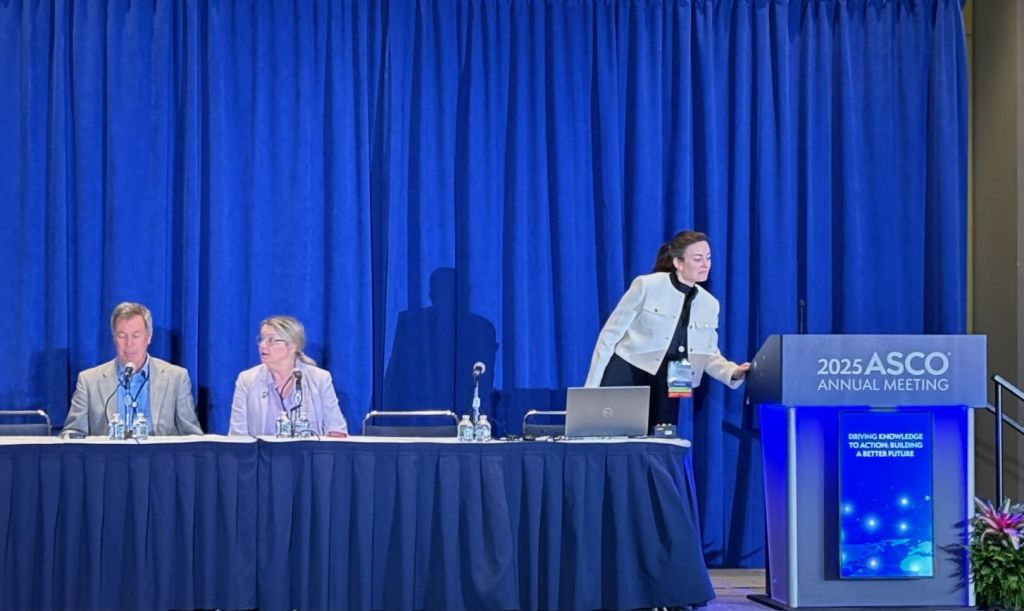
ANZGOG director Professor Alison Brand AM, on stage during the Endometrial Cancer Case-Based Panel Session at ASCO 2025
Cervical Cancer
Results from the PHENIX multicentre randomised trial confirmed that sentinel lymph node biopsy was associated with non-inferior disease free survival compared to lymphadenectomy in early stage cervical cancer and may reduce the risk of nodal recurrence and cancer-specific death. However, these results should be interpreted with caution as most patients in the trial had minimally invasive surgery which is no longer the standard of care in patients undergoing radical hysterectomy.
ANZGOG member and past Research Advisory Committee Chair, Professor Linda Mileshkin presented patient-reported outcome (PRO) data from the OUTBACK trial. Long-term symptoms including mental health, poor sleep, fatigue, hormonal issues, body image, urinary and bowel symptoms, and sexual function concerns, are common and persistent following chemoradiation +/- adjuvant chemotherapy for locally advanced cervical cancer (92% of patients had concerns regarding sexual activity at 3 years) and require dedicated survivorship care.
Circulating tumor DNA (ctDNA) analyses in participants of the CALLA trial showed that, like the findings in DUO-E, high baseline ctDNA levels were associated with an increased risk of progression and death, and undetectable levels after adjuvant treatment correlated with a reduced risk of progression and death.
Vulval Cancer
Findings from a single-arm phase 2 trial that evaluated the efficacy of the addition of pembrolizumab to concurrent chemoradiation therapy in patients with primary unresectable, incompletely resected, recurrent, or metastatic squamous cell carcinoma of the vulva, were presented. Results were encouraging with an overall response rate of 75%. The 6-month recurrence-free survival rate was 70% and the median PFS was not reached. The addition of pembrolizumab did not lead to any unexpected adverse events. Based on these results chemoradiation with pembrolizumab could be considered in patients with primary unresectable or incompletely resected vulval cancer, however more biomarker research is needed to guide patient selection.